In the Flow
 

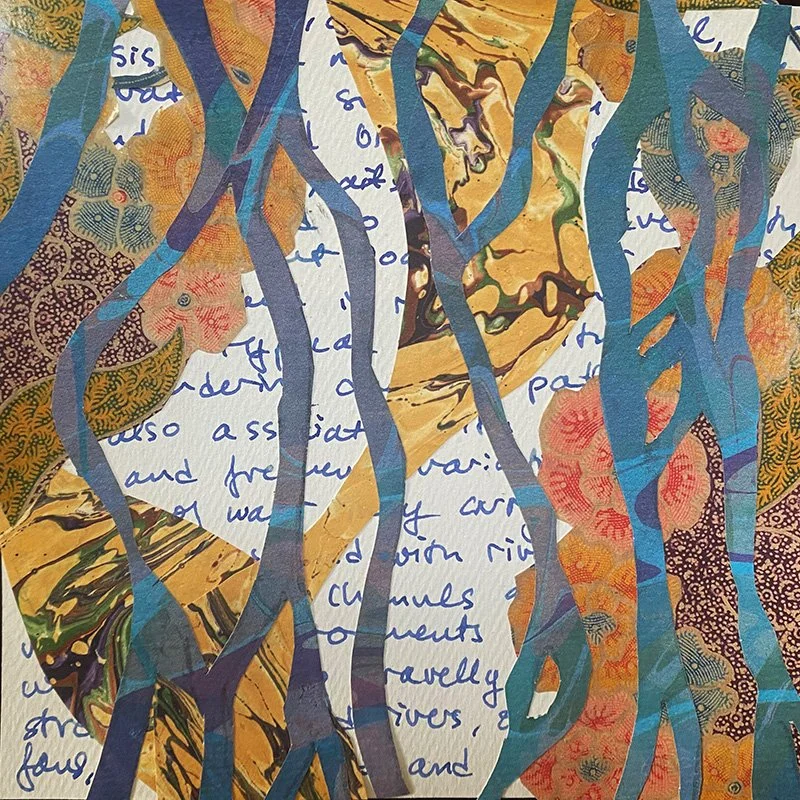
Collage by Helen Sword

When you fantasize about writing freely and prolifically, what metaphors spring to mind? 

For many writers, those rare periods of effortless productivity when swirling ideas coalesce and perfect sentences appear as though by magic on the page can be summed up in a single word: flow.  

The opposite of flow is frustration, academic writers' most frequently mentioned emotion word.  (See Air & Light & Time & Space: How Successful Academics Write, Chapter 10).  Writers sometimes invoke intestinal blockages (“constipation”), plumbing blockages (“a feeling of being clogged”), and blocked waterways (“stuck in the quagmire of detail”) to describe their feelings of frustration when their sentences don’t flow.

The recent death of psychologist Mihaly Csikszentmihalyi inspired me to revisit his classic book Flow: The Psychology of Optimal Experience, which I highly recommend to anyone wanting to deepen their creative practice.  Csikszentmihalyi defines flow as a state of utter absorption in a task that lies just beyond the limits of our abilities, neither so easy that we find it boring nor so challenging that we find it impossible:

  • It is what the sailor holding a tight course feels when the wind whips through her hair, when the boat lunges through the waves like a colt—sails, hull, wind, and sea humming a harmony that vibrates in the sailor’s veins. It is what a painter feels when the colors on the canvas begin to set up a magnetic tension with each other, and a new thing, a living form, takes shape in front of the astonished creator. . . . The ego falls away. Time flies. Every action, movement, and thought follows inevitably from the previous one, like playing jazz. Your whole being is involved, and you’re using your skills to the utmost. (pp 3, 16)

According to Csikszentmihalyi, anyone can learn to enter the flow state more or less at will by setting up the right conditions, including an uninterrupted period of time in which to work and an attitude of willingness rather than resistance.  Yet even when all of these conditions are in place, the flow of writing can remain elusive, more like a magic spring guarded by a fickle muse than a steady stream of words to be turned on or off at will. 

The problem, I suspect, is that writers tend to conflate what Csikszentmihalyi calls “the flow state” with the easy flow of perfectly formed sentences onto the waiting page.  In fact, we can be "in flow" at any stage of the writing process: not just when our words are flowing freely but also when we are deeply absorbed in the pleasures of brainstorming, mind-mapping, pre-writing, or polishing. 

I created this week's collage while in a state of flow, happily immersed in the challenge of visually representing the concept of flow in all its beauty and complexity.  I started with an aerial photograph of a braided river, then layered meandering channels of marbled blue paper over hand-inked text and patterned paper invoking geological and botanic forms. 

The creative process, like a braided river, is a delicate ecosystem prone to both silting and flooding.  As writers, we can find flow in both the silt and the flood, in contemplative silence as well as in the headlong rush of new words.  


Subscribe here to Helen’s Word on Substack to access the full Substack archive and receive weekly subscriber-only newsletters (USD $5/month or $50/year).

WriteSPACE members enjoy a complimentary subscription to Helen’s Word as part of their membership plan (USD $15/month or $150/year). Not a member? Join the WriteSPACE now and get your first 30 days free.
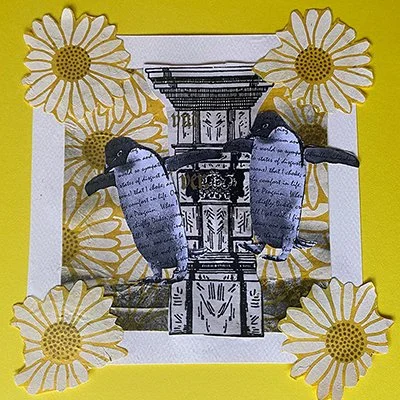

 
Happy Penguins
 

What do penguins have to do with pleasure in writing?  Everything!  

Researchers have found that when we come to a writing task in a positive frame of mind, we are likely to perform it more skilfully, creatively, and with greater enjoyment than when we arrive at the task burdened by anxiety, anger, or doubt. Behavioral psychologist Barbara Fredrickson calls this phenomenon the broaden-and-build cycle of positivity: our successful performance of a task generates an ever broader base of confidence and enjoyment that we can build on, in turn, the next time we undertake that task. 

Crucially, we can access the broaden-and-build cycle even when the positive emotions that get us there have been externally rather that internally induced.  I call this the happy penguin effect, based on a study in which Fredrickson and her colleagues invited student volunteers to perform a simple writing task immediately after watching a short video calculated to induce either neutral emotions (autumn leaves gently falling), negative emotions (two people engaged in an escalating argument), or positive emotions (penguins at play). 

The researchers reported that the study participants who watched the playful penguin video went on to write significantly longer, livelier, and more inventive responses than those in the other two groups.  In other words, playful penguins can help you become a more productive writer -- not to mention a more creative and colorful one.  (The penguin study is described in Fredrickson's aptly titled book Positivity: Discover the Upward Spiral That Will Change Your Life).  

Here's what John Ruskin, the famously curmudgeonly Victorian art critic, had to say about the power of penguins to cheer up even the grumpiest of writers:  

  • When I begin to think at all, I get into states of disgust and fury . . . and have to go to the British Museum and look at penguins till I get cool. I find penguins at present the only comfort in life. One feels everything in the world so sympathetically ridiculous. One can't be angry when one looks at a penguin. (John Ruskin, letter to Charles Eliot Norton, 4th November 1860)

The sooner we can hoist ourselves and our writing onto that upward spiral of positivity, the higher we will climb.  And penguins -- or any other stimulus that shifts our pre-writing mood from gloomy to joyful -- can help us get there.

To get started, check out my new Happy Penguin video, featuring the voice of my fabulous friend Caitlin Smith and a cameo appearance by my dog Freddie. (Freddie loves penguins too!) If Caitlin's soaring jazz vocals don't put you in the mood for writing, I hope they'll at least get you up and dancing. Check out my other YouTube videos while you're on the channel (especially the Purple Penguin), and please don't forget to subscribe.

What are your happy penguins?    


Subscribe here to Helen’s Word on Substack to access the full Substack archive and receive weekly subscriber-only newsletters (USD $5/month or $50/year).

WriteSPACE members enjoy a complimentary subscription to Helen’s Word as part of their membership plan (USD $15/month or $150/year). Not a member? Join the WriteSPACE now and get your first 30 days free.


Writing and Beauty
 

On Tuesday October 19, the WriteSPACE community was treated to a conversation on “Writing on Beauty” with esteemed special guest and genre-defy writer Professor Douglas Hofstadter.

Doug has always been “a strange loop.” His book Gödel, Escher, Bach: An Eternal Golden Braid won both the Pulitzer Prize for non-fiction and the National Book Award in 1980. He is a more-than-transdisciplinary thinker who teaches cognitive science and comparative literature (among other things) at Indiana University. Doug is also Director of Indiana University’s Fluid Analogies Research Group (FARG), where he and other FARGonauts pursue the creative analogy-making holy grail of “fluidity.” Doug’s enduring passion for languages, music, and the sciences blends seamlessly with his ongoing discursive explorations in poetry, translations, script-inspired “Whirly Art,” and wordplay - all of which keep him writing and “perpetually in search of beauty.”

In the first hour of this WriteSPACE Special Event, Doug and I discussed how his intellectual autobiography informs his writing and his concept of beauty. Doug told us about some of his childhood experiences and influences - one of the most prominent being his mother’s beautiful handwriting - and how these early encounters informed his later work. Doug shared pieces of his writing and pointed out various curiosities, such as layers of inherent ambiguities, strategic uses of conceptual, lyrical, and formatting wordplay, and playful examples of self-referential sentences. He also compared two different English translations of the same Pushkin poem to show how they differed in patterning, meaning, and aesthetics.

 Quote of the hour (Doug’s definition of beauty): “Beauty is a unity of things that come together in some unexpected, special, natural and powerful way.”

In the second half, Helen ran us through two Hofstadter-inspired word play activities. First, we wrote a description of an object without using the letter ‘e’ and then in small breakout groups, we used the prompt ‘write a self-referential sentence’ to see what emerged.

 Quote of the hour: Sentences that implode!

The full video of this spectacular session is available for members in the WriteSPACE Library.

Not yet a member? Join the WriteSPACE now with a free 30 day trial, and access our full Library of videos and other writing resources.

Subscribe here to Helen’s Word on Substack to access the full Substack archive and receive weekly subscriber-only newsletters (USD $5/month or $50/year).

WriteSPACE members enjoy a complimentary subscription to Helen’s Word as part of their membership plan (USD $15/month or $150/year).

 
Sea Glass
sea glass

Original collage by Helen Sword


When my children were young, we used to scour the beach together for sea glass, which we would take home and sort into jars and bowls: burnished browns, textured greens, clear glass etched to a misty white. Occasionally we might find a nugget of red, blue, even purple glass -- precious treasures to be rubbed between our fingers and held up to the light.

Those fragments of glass, I told my children, started out as something useful: a bottle or container, a part of a whole. Eventually those containers got emptied, smashed, discarded; the broken glass lay sharp and angry on the ground, a hazard for tender feet, reviled as trash. But some lucky pieces found their way into the sea to be tossed by the waves and scoured by the sand. Weeks or months or years later they washed back up onto the beach, their jagged edges now polished smooth.

Writing is like sea glass. Sometimes the words flow from us like running water or leave our hands in shapely sculptures. But more often our sentences need to be broken up and churned around by the ocean swells until, like the missing father of Shakespeare's Tempest, they undergo "a sea change / into something rich and strange."

Writers, too, are like sea glass. We start out as empty vessels, filled only with potential. We end up polished by time, textured by the waves, more precious and beautiful than before.

Tumble down to the tidal zone
and beach yourself here beside me
where vision and substance meet:
where the earth flattens and floods
and smashed beer bottles
wash up at our feet
disguised as amber jewels.


Subscribe here to Helen’s Word on Substack to access the full Substack archive and receive weekly subscriber-only newsletters (USD $5/month or $50/year).

WriteSPACE members enjoy a complimentary subscription to Helen’s Word as part of their membership plan (USD $15/month or $150/year). Not a member? Join the WriteSPACE now and get your first 30 days free.


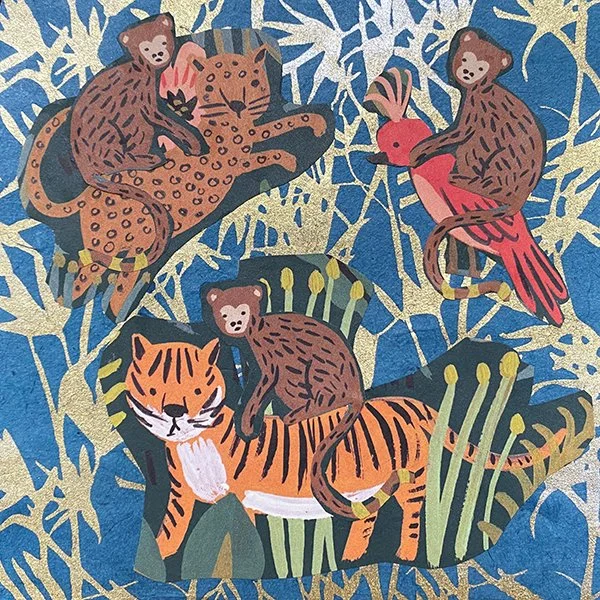
Monkeys on Your Back

Original collage by Helen Sword


Years ago, when I stepped into a university leadership role, a wise colleague gave me some advice.

“Every day,” he told me, “people will walk into your office with monkeys on their back, and they'll want to hand their monkeys over to you. Your job is to help those people as much as you can – but make sure they leave your office with those monkeys still firmly on their own backs rather than on yours.”

These days, most of my monkeys are of my own making: writing projects to push along, YouTube videos to script and film, online workshops and Stylish Writing Intensives to run for other over-committed writers (like you?)

The 800 pound gorilla that had been crushing all the other monkeys on my back until recently – a major book manuscript – has wandered off into the jungle now, though it’s bound to come lumbering back from time to time to be stroked and fed.  Meanwhile, the smaller monkeys keep chattering away.  In fact, I suspect that they're breeding back there.  Every time I shuffle one monkey off my back, it seems that two or three more arrive to take its place.

What writing monkeys are clinging to your back, and how can you carry them more gracefully?

The first step is to acknowledge your monkeys, give them nicknames, maybe even dress them up in a comical clothes.  I learned this trick from Mark Bryan and Julia Cameron's wonderful book The Artist's Way at Work, which contains an exercise called “The Forest Environment”:

  • Describe your business environment. What kind of forest is it? A jungle? A maple forest? . . . . Name the dangerous predators in your forest. Give them animal identities. Any bullying grizzly bears? Cunning sidewinders? Wily faxes? Deadly scorpions? Which are you? . . . . Name and describe the beautiful elements of your forest. Any waterfalls, meadows, bushes heavy with berries?

The next step is to teach your monkeys to ride lightly.  Have you ever carried a toddler in a baby backpack? If yes, you’ll know that children feel much lighter when they’re wide awake, sitting up tall and shifting their weight to match yours; only when they start squirming or fall asleep do they throw you off balance.  It's exactly the same with monkeys. You want them to ride lightly on your back, not to distract you with their antics or hang there like a dead weight.

Monkeys need lots of exercise; they’ll whine and wiggle unless you give them a regular chance to romp.  Try freewriting in a notebook about how all those writing tasks are coming along, or talk about them with a friend over coffee.  Monkeys thrive on fresh air.

Monkeys also need plenty of rest – and so do you.  Do you have a secure play area where you can leave your monkeys while you’re exercising, relaxing, sleeping?  You don’t need to carry them on your back all the time – that’s no good for you and no good for your monkeys!

Writing a weekly newsletter for thousands of subscribers sometimes feels like quite a heavy monkey to carry around.  But it helps for me to picture myself as a leaping leopard or a jaunty parrot parading through the jungle with a well-fed, curious monkey on my back rather than a grumpy, screeching one. 

Isn’t the human imagination a wonderful thing? 


Subscribe here to Helen’s Word on Substack to access the full Substack archive and receive weekly subscriber-only newsletters (USD $5/month or $50/year).

WriteSPACE members enjoy a complimentary subscription to Helen’s Word as part of their membership plan (USD $15/month or $150/year). Not a member? Join the WriteSPACE now and get your first 30 days free.


The Thesis Whisperer Speaks
Original collage by Helen Sword

Original collage by Helen Sword


On Tuesday September 28, our WriteSPACE international membership community welcomed special guest Professor Inger Mewburn, better known as the Thesis Whisperer, as the special guest at our monthly Special Event.

Inger is Director of Researcher Development at the Australian National University and the author of numerous scholarly papers, books, and book chapters about research education and post-PhD employability. If you're not yet familiar with Inger's fabulous long-running blog at www.thesiswhisperer.com, be sure to check it out!

In the first hour of this 2-hour Special Event, I talked with Inger about her work as an influential writing scholar, research developer, and blogger. She told us how and when she started the Thesis Whisperer blog, why she recently stopped publishing guest posts, and what projects she’s working on now — for example PostAc, Postac, a tool for PhD students in search of non-academic jobs. I especially loved hearing about her childhood as the daughter of a computer technician; she used to sit with her back against his big mainframe computer to keep warm and build card houses out of stacks of used punch cards.

Quote of the hour: “The future is Search.”

In the second hour, Inger took us through a hands-on writing workshop based on her recent book How to Fix Your Academic Writing Trouble. We learned why so many academic authors write hard-to-read sentences and explored some simple ways to fix them.

Quote of the hour: “The English reader is not a good guesser.”

If you’re a WriteSPACE member, you can watch an edited video of the conversation and workshop with Inger Mewburn in the Library.

Not yet a member? Join the WriteSPACE now with a free 30 day trial, and access our full Library of videos and other writing resources.

Subscribe here to Helen’s Word on Substack to access the full Substack archive and receive weekly subscriber-only newsletters (USD $5/month or $50/year).

WriteSPACE members enjoy a complimentary subscription to Helen’s Word as part of their membership plan (USD $15/month or $150/year).

 
Renovate Your Writing Space
 
 
Original collage by Helen Sword

Original collage by Helen Sword


When was the last time you renovated your writing space?

I don't just mean the physical space where you write, although that's important too.  Maybe it's time to clear your desk, brighten your room with colorful artwork and fresh flowers, and polish the windows to let in the light.  Or perhaps you could head out to a cafe with your laptop or walk to the park with a notebook in hand -- anything to stimulate your senses and get your body moving.

But what about the writing space inside your head?  Is it cluttered with dust bunnies, to-do lists, negative thoughts?  When you sit down to write, what emotions do you bring with you across the threshold into that sacred space?  Are there any distractions that would be better left outside the door?  

I would love to help you find and flourish in a multidimensional "SPACE of Writing," a space of productivity and pleasure that is:

  • Socially balanced, offering opportunities for social interaction, collaborative intimacy, and solitary writing;

  • Physically engaging, inviting you to bring your body as well as your mind to the party;

  • Aesthetically nourishing, infusing your writing practice with color, beauty, and style;

  • Creatively challenging, encouraging cognition, choice, and change; and

  • Emotionally fulfilling, amplifying and celebrating joy in writing.

Does that kind of writing space sound appealing to you? If yes, I hope you'll come visit us in the WriteSPACE, an international community devoted to helping you become the stylish, savvy, satisfied writer you long to be.


Subscribe here to Helen’s Word on Substack to access the full Substack archive and receive weekly subscriber-only newsletters (USD $5/month or $50/year).

WriteSPACE members enjoy a complimentary subscription to Helen’s Word as part of their membership plan (USD $15/month or $150/year). Not a member? Join the WriteSPACE now and get your first 30 days free.


Out the Door
Original collage by Helen Sword

Original collage by Helen Sword


We raise them, we nurture them, and then we let them go.  There's nothing harder -- or more exciting! -- than watching our darlings head out into the big wide world to make their own way. 

Maybe the book that you wrote for an academic audience will get picked up and read by a dog trainer, a preacher, or an engineer.  Maybe your daughter will write home to let you know that he is now your son.  Who knows what will happen next? 

This month, I have let several of my darlings go.  Now I've got that familiar pit-in-the-stomach feeling: How will they fare on their own?  What surprises do they have in store for me?  What will I learn from them? 

  • The book: In early September, I pushed a book manuscript out the door -- a major research and creative project that I've been working on for at least four years, now in the hands of anonymous referees. Optimistically titled Writing with Pleasure, my book aspires to surprise and delight. But have I got the tone and content right? Will my readers hand me brickbats or bouquets? Patience, patience. . . .

  • The artwork: I've started heading up my blog posts with my own handmade paper collages, another scary but exciting prospect. I've long resisted using the kinds of stock images that you find on most writing websites -- laptop computers artfully arranged on improbably uncluttered desks, good-looking people with designer glasses writing in poses of deep concentration -- but can I do better? Watch this space. . . .

  • The website: I'm in the midst of a major website renovation, which means that every minor tweak (or error!) immediately goes public. I hope that you'll like the results of my home improvement, which includes streamlined navigation, this new blog creamed from my newsletter posts, and a calendar that you can use to find the dates and times of events in your own time zone.

What darlings do you have lined up, just waiting for you to gently push them out the door?  It's terrifying -- but it's worth it.   


Subscribe here to Helen’s Word on Substack to access the full Substack archive and receive weekly subscriber-only newsletters (USD $5/month or $50/year).

WriteSPACE members enjoy a complimentary subscription to Helen’s Word as part of their membership plan (USD $15/month or $150/year). Not a member? Join the WriteSPACE now and get your first 30 days free.

 
Writing for Writing Grants
moneybags.png
 

At our recent WriteSPACE Special Event on “Writing for Writing Grants,” special guest Professor Karim Khan from the University of British Columbia joined me for a wide-ranging conversation about why professional development for writers is so important and how you can sharpen your own writing style -- and get someone else to pay for it!

Our discussion focused mainly on academic and professional writers seeking funding in support of advanced writing courses such as the Stylish Writing Intensive. However, Karim’s advice could easily be adapted by any kind of writer applying for any kind of funding. Here’s a brief summary of his key points:

  • Be creative about where you look for funding. Research grants, travel funds, teaching and learning enhancement grants, and even philanthropic gifts are all potential sources of support.

  • Consider stitching together funding from more than one source and/or offering to cover some of the cost yourself. (In many countries, professional development activities are tax deductible.)

  • Frame your funding request in terms of the benefits not just to you but also to the funder -- for example, “This course will better equip me to draft that strategic plan you wanted me to help with” (good for the department) or “This course on stylish writing will help me increase the outreach and impact of my research” (good for the institution and the world).

  • Promise to bring something back -- for example, after attending the Stylish Writing Intensive you could offer to run a writing workshop for the graduate students in your department.

  • Ask the facilitator of the event that you’re applying for to send you a letter of invitation or recommendation in support of your application. (Contact me if you would like me to provide you with such a letter for the Stylish Writing Intensive and/or WriteSPACE membership; I’d be delighted to do so!)

In the second hour of the live event, we walked participants through a series of prompts designed to help them craft a strong application, whether for writing development funding or for any kind of grant. You can replicate the workshop on your own by playing the second half of the video, and responding to the prompts yourself.

Warm thanks once again to Karim for a useful and stimulating event!

A recording of this WriteSPACE Special Event is now available for members in the WriteSPACE Library.


Subscribe here to Helen’s Word on Substack to access the full Substack archive and receive weekly subscriber-only newsletters (USD $5/month or $50/year).

WriteSPACE members enjoy a complimentary subscription to Helen’s Word as part of their membership plan (USD $15/month or $150/year). Not a member? Join the WriteSPACE now and get your first 30 days free.


Sharpen Your Saw
 
saw.jpg

Have you ever heard the story of the woodcutter who has been laboring all day to cut down a tree? When a passer-by suggests that they pause to sharpen the saw, the woodcutter replies impatiently, “But I don’t have time!” (Adapted from Steve Covey's book The Seven Habits of Highly Effective People).

Maybe it's time for you to step away from that tree and sharpen your saw. When was the last time you read a book about stylish writing, or attended a writing workshop, or otherwise devoted a few hours or days to developing your craft as a writer?

You could start small -- for example, by watching one of the free Wordcraft videos on my YouTube channel -- or go for the gold standard and invest in the Stylish Writing Intensive, an immersive 3-day retreat for writers who want to hone their craft and come out with the sharpest blade in the forest. I’d love to see you there!


Subscribe here to Helen’s Word on Substack to access the full Substack archive and receive weekly subscriber-only newsletters (USD $5/month or $50/year).

WriteSPACE members enjoy a complimentary subscription to Helen’s Word as part of their membership plan (USD $15/month or $150/year). Not a member? Join the WriteSPACE now and get your first 30 days free.


Gathering to Write
SWI 5.jpg
 

On Thursday July 22, our WriteSPACE Special Event “Gathering to Write” started at 11 am Israeli time and gathered energy as the world turned, picking up a second round of participants 12 hours later.

Whether or not you made it to either part of the live Zoom gathering, we hope that you'll check out the wonderful padlet wall created by our brave participants, who were shunted into breakout rooms with random strangers and instructed to "design a writing-related gathering of any kind: large or small, serious or playful, online or onsite...."

Please honor their enthusiasm and insight by taking a few minutes to read their contributions and leave some supportive comments. You might even want to reach out across time and space to connect with other writers whose ideas resonate with yours. (If any actual gatherings or long-term writing relationships emerge from this exercise, I'd love to hear about them!)

An edited video of the event is available in the members-only WriteSPACE Library.

Warm thanks to everyone who participated -- especially my wonderful co-hosts Tzipora Rakedon and Pat Goodson, moderators Brie McCulloch and Victoria Silwood, and panelists Orit Rabkin, Sarah Lurie, Nina Ginsberg, Hussain Shah Rezaie, Danny Valdez, Qian Ji, Lynne Murphy, and James Corazzo.

We'd love to see you at our next WriteSPACE gathering!

Kohokohi kohikohi pīngao e mo ngā kete raukura o te rangi e.
Gather up pīngao [sedge leaves from the sand dunes] to weave the treasured baskets of the sky.

(Maori proverb)

A recording of this WriteSPACE Special Event is available for members in the WriteSPACE Library.

Subscribe here to Helen’s Word on Substack to access the full Substack archive and receive weekly subscriber-only newsletters (USD $5/month or $50/year).

WriteSPACE members enjoy a complimentary subscription to Helen’s Word as part of their membership plan (USD $15/month or $150/year). Not a member? Join the WriteSPACE now and get your first 30 days free.