
The Freddie Walk
Transcript of Helen Sword’s podcast episode The Freddie Walk.
Welcome. I'm Helen Sword, and this is Swordswings. Today I am out and about for a walk with my little dog, Freddie. So we're going to pay attention to what Freddie notices, and I'm going to see if I can transform Freddie's observations into writing prompts, thinking prompts, and ways into your writing practice.
We've already left the house. Freddy's done his business, as we say. So he's all happy and trotting now. Just at this moment, he spotted another dog on the other side of the road. And boy does he get excited when he sees another dog! I used to think that there was a combination of fear and maybe just a little bit of almost aggressiveness in him, the way he would respond to some of these dogs with a growl, a bark.
He tends to be quite suspicious. And then I realized at some point that a lot of his not-very-social behavior had to do with his desire to protect me. So almost everything he does—when he lunges at a person or a dog, or he barks when somebody comes to the door, or I'm taking a bath and he comes into the bathroom and lies with his front feet on my towel on the floor—all of these things, he's protecting me. He's guarding me. It's made me think about my own ideas, my own ways of thinking. Am I as reactive as Freddie? Am I as fiercely guarding things? Is that a side of Freddie's way of being that maybe I don't want to be copying? So I'll give you a moment to think about that. Freddie and I are continuing to walk.
It's sunrise just now. A beautiful spring day. I don't usually get out the door quite this early, but today I thought, no, let's go explore the world with Freddie. So he's moved out of his guarding mode. Now he's in his curious mode, trotting along, nose sniffing everything, looking around. We just walked along the shell path that leads along the foreshore.
It’s a sort of gravel road, something that's been laid down for people to walk upon. But we've had some heavy rains the last few days, torrential rains. And I noticed that on the shell path and the dirt underneath it, the shells have been completely washed away. And the dirt beneath, the compacted soil, has been sort of carved out in these runnels by the rain.
Freddie liked the smell of that, that kind of fresh after-the-rain smell where everything's been turned over. And I found myself captivated by the patterns. I could literally see where the flow had been. The process had left itself as a very interesting product that somebody will have to go and repair. It's not an intentional product.
It got me thinking about metaphors of flooding. Of things that might look like destruction but also bring beauty into our lives sometimes. Just paying attention to those details. I don't think I would have been looking at the ground if I weren't trying to walk like Freddie.
So a metaphor to think about here: is my writing the path that I'm treading that gets, if not destroyed, at least kind of pockmarked and messed around when floods of ideas come, or perhaps floods of emotions that aren't quite behaving in the way I wanted them to. Or, am I? Somehow, is my writing? Can my writing be the flood that leaves a mark on something else? What kind of a mark will that be? Are there times when we're actually displacing what's already there?
And now we're walking down some stairs onto a little beach. Maybe you can even hear the lapping of the waves. It's not a proper beach. It's an inner harbor sort of beach, but we get some waves from the wakes of the boats going by. Very early in the morning, the sun just coming up. And I've discovered two, what look like Adirondack chairs, on the beach, facing out to the water. They are for anyone to sit in. I'm not going to do that right now because they are soaking wet from the dew. Freddies's having a little sniff. I'm going to keep him away a little bit to make sure he doesn't do anything else to those chairs.
Changed my mind. I think I've got to! No, I'm not going to sit on them, they're too wet, but I'm going to stand as though I were sitting on them and just contemplate this view for a moment. So often I'm walking, walking, walking, moving from one place to another. I don't stop and just look, just be, just feel that rising sun on my face as it begins to warm the chilly morning air.
So wherever you are, whether you're walking, whether you're sitting, whether you're moving around your own residence or office, I invite you to stop for a moment.
Stop. Listen. Look around.
What's one thing that you're noticing right now that you might not have noticed if you hadn't stopped?
I'm noticing sounds that I hadn't realized were there. The clump clump of my feet had drowned out those gently lapping waves. I'm feeling that sun on my face, so low that I hadn't thought about its warmth. But there it is. There it is.
And now I'm watching Freddie. What's he thinking about? Oh, I can see, he's thinking about that big dog, that pointer down at the end of the beach. Here's the interesting thing: Freddie's entire attention is pegged to that dog. He's sitting, he's watching. He's worried that that dog is going to come to us. And he'll respond in a way that will look like a fluffy little white dog being scared of a big dog.
But I know that inside Freddie's lion heart, he's actually trying to protect me. So, as a writer, what am I learning from Freddie there? I think a very big one that I see with a lot of the academic writers I work with especially, is this fear of things that are way at the other end of the beach, these sort of bogey-like presences, the critical reviewer, that voice in your ear, that imposter syndrome, that question, can I do it? Am I good enough? And sometimes those things never even get near us. They're just far away. Sometimes, believe it or not. Those things do get near us and they just turn out to be a big, galumphing Labrador that really just wants to lick our face and whack our legs with its tail.
The jury's still out on this big dog. It's a little ways away, sniffing in the grass. Its owner's got one of those big long plastic sticks with a tennis ball. So I predict that as soon as the dog gets a chance to chase the tennis ball, then things will get exciting. So let's just look and watch. What happens? What do we do when the threat moves towards us?
[Freddie barking in the background]
Well, that was Freddie. He's on the lead and the other dog's off the lead, so of course that's always hard when we feel constrained and we're threatened by something that seems to be free. The other dog was vaguely interested, but more sort of like, what is this little yuppie thing? I don't think he was actually there to eat Freddie or to eat me, but Freddie kept us safe. You could hear that.
Now, what I know about myself is that I'm like Freddie. If I perceive a threat, I come out swinging, I was going to say, but I come out barking, yapping. I come out saying, you're threatening me. Get away from here. I don't want this. And sometimes I wonder what would happen if I could relax from that protective mode, not assume the worst of every comment, every approach, and respond with curiosity and openness, rather than with that reactive bark bark bark.
So that's something that I need to not learn from Freddie, but perhaps unlearn from watching Freddie's example. He's not a relaxed dog, and he causes some real issues with his overly protective behavior. I wish that he could be a bit more chill around other dogs, and it's not just his size. I know other dogs, I know a little dog named Leo, the size of a dachshund, though he's some mix of goodness knows what. He has this sort of permanent smile on his face. Leo stands for Low Earth Orbiter, by the way. Perfect name. He's not at all Leonine. He has these little splayed feet. And he meets every dog with that little smile. Like Hello! You must be my friend! Do I, as a writer, as a thinker, want to be like Leo?
That's a good question. I'm not sure I have it in me to be quite that open, that fearless, but it's wonderful to watch. It's wonderful to see that in a little dog. So this is maybe making me think as a few more dogs go galloping past us, but Freddie managed to stay calm. They didn't come too close. But right now I'm seeing all three or four other dogs on the beach besides Freddie, even now at this early dawn hour. And I think another interesting way of going for a dog walk would be simply to observe other people's dogs, to think about the different characteristics of those dogs, to imagine each of those dogs as a different kind of writer.
Which are the ones who are just jumping in, romping around, having a fabulous time? Which are the ones that are threatening other people, other dogs? Maybe not intentionally, but just because they're big and have long teeth. What are the ones that have that kind of aggressive stance? We used to have a Wheaton terrier who would stalk other dogs and it wasn't good. The other dogs got anxious. The owners got anxious, even though she was this beautiful fluffy thing that looked like a big teddy bear. She was essentially always thinking, how can I knock that other dog over? Freddie's always thinking, how can I protect Helen from that big dog? I think maybe it's also himself.
And I watched some of those other dogs. They're so free. They're so joyful. I want to be like that. I want to write like that! Sometimes I don't want to write like Freddie, always looking around, so worried about everyone else.
So let's walk a bit. Let's notice. Notice what's around you. Notice the sound of your steps. What else can you hear right now? I'm hearing a bit of birdsong. I'm hearing the splish splash of that dog going out into the water. Ooh, there's another thing I might be able to learn from some of these dogs. I don't want to go in the water, it looks cold! If you're a dog that really loves a ball, and that tennis ball, or that stick gets thrown in the water, you're gonna go after it.
Ah, here he comes, after that orange ball. Run, run, run! He's got it. He's got it in his mouth. And then he's gonna take it back to his owner. And they're gonna play that game again. And again. And again. That dog never gets tired of the game. That's how I want to be as a writer. Always chasing the next ball with that same enthusiasm, that same gallop. And I wouldn't mind having those lean muscles while I do it. I wouldn't mind having that speed. Sometimes I feel more like a bulldog or one of those dogs that just can't quite get all its limbs in motion because their little skinny limbs are carrying a great big trunk.
All right, we've left the beach now. We're walking past some houses. I'm always looking at the houses, looking at how people furnish things inside, if I can get a glimpse. Looking at their gardens. I guess there's a bit of me always thinking. Oh, I like that house. What would it be like to live in a beautiful house like that? Or, look at this house. These people don't take very good care of it. They haven't painted in ages. It's falling apart. What's wrong with them? There’s a lot of judgment in my assessments of real estate. Very human. Very conditioned. Very first world, as they say.
Meanwhile, there's Freddie trotting along beside me. A first-world dog for sure. He's very expensive to get groomed and looked after in the way that he's used to. Definitely a luxury dog. But look at him. He's just a dog! [Laughs] He trots along. I look at the big, expensive houses, and I feel house envy. I feel all those sorts of things…and what about Freddie? He's low to the ground, and he's just paying attention to what comes to him through his senses. So I'm going to stop looking at those houses through the lens of judgment and the lens of money. And I'm going to try to spend a few minutes looking at the shapes, looking at the colors, looking at the interactions of the trees, the bushes, and the human-built structures.
I'm going to listen to the birds. I'm going to marvel at that massive tree up the hill. And I'm going to leave you some space to do the same. What are you noticing now?
And now here's a writing prompt for you. Or a prompt to help you think about your writing:
Notice one thing that you're going to look at so closely, you're going to remember so vividly, that when you get home, you can say, now ‘what was that one thing I tucked away in the back pocket of my mind?’ To bring out at just this moment and perhaps use as a way of jumping back into my writing.
I'll tell you mine in a moment. First, I'm going to give you a minute or two to find and formulate your own. One thing you're noticing that you can remember and take home with you and think about for whatever reason in whatever way when you sit down—or stand up—to start writing.
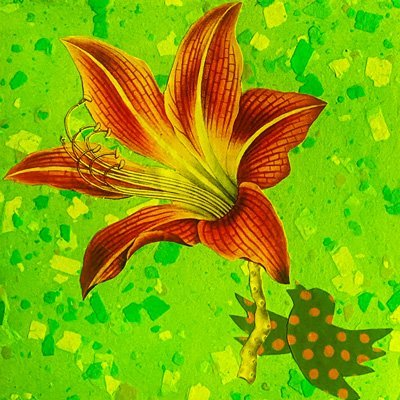
And here's mine. I'm walking past a house with these big jungly sort of trees and bushes. It's got the most extraordinary vine growing on it. It looks exactly like a vine that we have in our back garden, but the difference is that ours doesn't seem to bear any flowers, whereas this has the most enormous lily-like flowers. Big stamens, huge yellow blossoms practically the size of a, well, maybe not a dinner plate, but a dessert plate.
There's one that's open, just looking at me. It's magical. It's so beautiful, I'm going to take a photo of it in a minute. But on some of the other branches of the vine, all tangled up, there are blossoms that haven't yet opened. And they're extraordinary too. One of them's shaped almost like a fish. Or they could be a fruit. Here's one that's still green, it hasn't even turned yellow on the outside. Oh, and here's one just emerging from the leaves, you can barely see it. If I came upon this and hadn't seen the flower, I might have thought that this was something I could eat.
And that's just going to keep pushing out, and it's going to keep pushing out, and it's going to get bigger, and it's going to turn yellow, and it's going to take on this amazing sort of pouchy shape, like there's something inside. Ants are gonna start crawling out. I see a few that have made their way all the way up the vine because there must be something incredibly delicious and sweet there.
And then, finally, bit by bit, it'll take days, maybe it'll take weeks, each of those flowers—in its own time—is going to get to its full size and then open. And when it opens, the view of what's inside is going to be so extraordinary, so different from what I could have anticipated, from that pouchy shape on the outside.
And now, it's time to start up the hill. I'm in Tamaki Makaurau Auckland, New Zealand. And this city was built on volcanic hills. We call them mountains, but they're not mountains, they're hills. All these little mounds because the whole city is a volcanic field. Slightly alarming. All that underground power there.
It's what comes from living in a part of the world that was basically shaken up out of the sea. By the rubbing together of two major tectonic plates. And so I'm walking up something that is, in a sense, dead. I mean, it's not a living volcano. It's very old. It's got roads and paths on it now and some old military barracks.
Lots of people jogging up it, cycling up it. You'll hear my voice start to become more breathless as I walk up it. It's not actually that steep. And when I get to the top, I will get the most extraordinary view of the harbor. A 360-degree view. It's a place called North Head in Devonport, if you want to look that up on Google Maps: North Head, Auckland, Aotearoa New Zealand.
And it's a dawn morning in the spring. A half moon setting in the sky. I think it's a waning moon, I'm sure it is. We had a full moon just a few nights ago. So, a waning moon, turning its way down to the point where we can't even see it at all. But of course, the same moon's there, isn't it? Those are just our perceptions from Earth of a full moon or a new moon.
It's the same moon up there. It's the same moon. It's just the angle at which we're seeing it and seeing the sunlight bouncing off it. And as I get higher up this hill—Yeah, I'm going to exert myself more, but I'm going to see more and more. Right now, I'm high enough up that I can see Cheltenham Beach, far away. It's low tide, I can see the flats, the mud flats, where I used to take my kids when they were little to splash around. Kids are like dogs, aren't they? They just see what's in front of them. No judgment. So we think that we've got to have full tide and blue sea. That's the expense of real estate. For a kid, it's all about the low tide and splashing around in the mud. And for a dog, too.
So I'm going to leave you there with that. I'm going to leave you thinking about how you climb your own volcanic hill in your mind, what you'll see from the top, what you'll bring down from the mountain, and what you'll bring back from your walk to nourish and energize your writing. And Freddie's still just panting his way up the hill. He's much fitter than I am. He’s keeping an eye out for those other dogs. Well, there goes an electric bicycle! He’s keeping me safe from it all.
Happy writing everyone! I’ll see you and talk to you next time.
Helen