
The Chakra Walk
Transcript of Helen Sword’s podcast episode The Chakra Walk
Hi, I'm Helen Sword from helensword.com, and this is Swordswings, my podcast series for writers in motion. Whether you're driving or riding a train, out for a walk, or just pottering around in your kitchen, this recording will help you move yourself and your writing to someplace new.
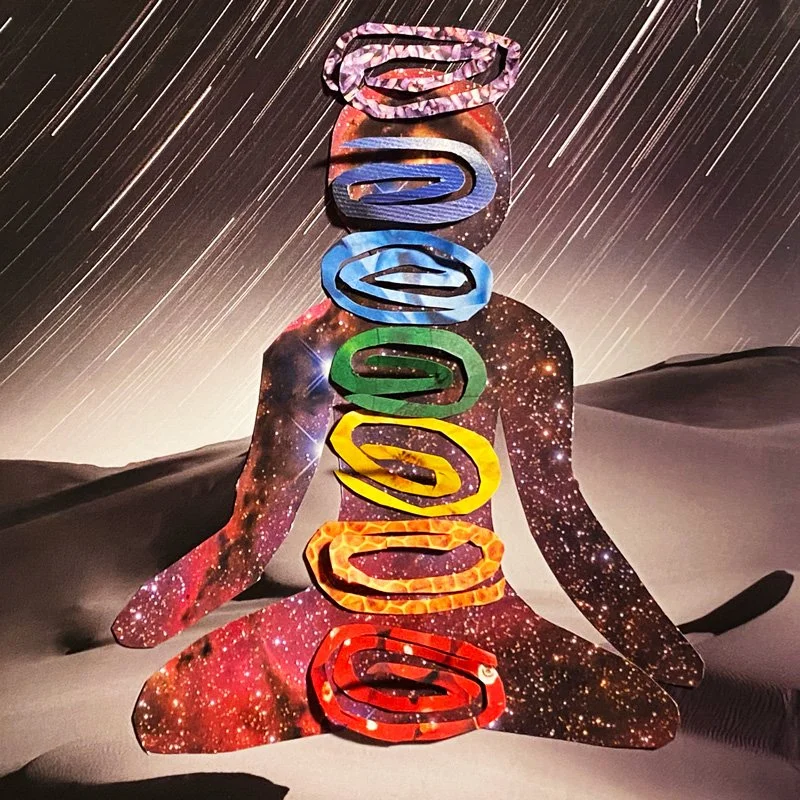
Today’s episode is called “Writing the Chakras”. In 2023 I talked with Michele di Pietro, an author, a Professor of Mathematics, and the Executive Director of the Center for Excellence in Teaching and Learning at Kennesaw State University. Michele has a long-standing interest in yoga, meditation, and the chakras, seven core yogic principles that, according to Michele, can help us find our ground, nurture our desires, build our power, find the love in our professional environment, grow our voice, evolve our vision, and build our legacy as writers and thinkers.
Let’s jump in to hear Michele explain what the chakras are and how they can help us reflect deeply about ourselves and our writing lives.
……
Helen: Right. Well, let's turn to the chakras, shall we? Can you first of all just explain to anybody here who has absolutely no clue, what are the chakras?
Michele: Absolutely. I have some images that I would like to share that might help illustrate if you've never seen this.
This painting goes by many names. Some people call it the Venus with drawers, and it's such a fascinating concept. Imagine if you could open the drawer and see what's in somebody's heart, what's in their gut, what's on their mind. And that's kind of, you know, what the chakras are, they're positioned, they're not in the thighs for sure [laughs]
Although there are chakras everywhere as energy in a sense. But in yoga philosophy, there's this idea that we have several bodies. Many other cultures have that idea in terms of mind, body, soul, all those layers. And in the energy body (which is the second layer, right after the physical body, and eventually you get to the bliss body, is the inner one, and all the other ones are sort of sheets covering the bliss body. So in the energy body, the whole body's energy, like we're made of energy in many ways. Electrical energy, if you want to be more scientific and other, all kinds of other energies.
There's energy, focal points, vortices of energy that are spinning through the body. So in the energy body, the prana Maya Kasha, you find seven chakras and they come along the spine.
And so at the bottom they are represented as flowers, lotus flowers. The spine is the main energy channel of the body. And just like in Chinese medicine, you have the meridians, for instance. In yoga philosophy, you have the Nadis, which are energy channels. The main one is the spine, it's called the Una. And then along that channel, there are seven main energy points. There are some other minor ones as well, from all the way from the base of the spine, our seat where we actually sit, to the head. And each one of them is a different energy and has a different function.
Another image that you sometimes see is this one with the two snakes. That's because the next two most powerful Nadis, or energy channels, are not vertical, but they go this way and that way they intersect. And they symbolize sort of sun and moon, masculine and feminine, giving and receiving energies that cross, that you want a mix of both of them and they spin around the chakras and they meet, actually they meet sort of inside the nostrils into the third eye. That's where they meet. And that is represented as snakes. And the whole snake imagery is, the whole idea behind Kundalini yoga is that there is this snake that's normally the goddess Kundalini, that is normally coiled three and a half times at the base of the spine. And so the point of doing this work is to awaken the snake, the Kundalini snake, like a snake charmer so that it awakens. And as it wakes up, it pierces all the chakras one by one. Activates them, sets them spinning in the right way. And that's ‘enlightenment’ or however you want to call that, a better life, higher consciousness.
And the point of that is that the chakras can have… they're usually blocked. We all have blockages somewhere. Academics might, as a group, as a generalization, might privilege the head. And then, and then they have blockages down here in the heart and in the body. And there might be some other patterns.
There's actually specific patterns in chakra theory…And the consequences of communicating, expressing what you really feel, consequences manifesting your dreams. You have lots of ideas, but they don't come to fruition maybe, or depending on what the blockages are. And the blockages could be excessive. There's too much energy in that chakra, and it's taking energy from some other chakras, or it's defective. And so the point is to bring them into balance, into harmony with each other. So chakra balancing is the concept that we try to do. So that's the general theory. And then out of this thing, one could note that's where we get the image of the caduceus, the medical thing, it comes from here. It's, that's how it went from Indian culture into Western culture. And it was translated, absorbed, appropriated in that way. So yeah, so those are, that's the concept.
And then you get into each one of them. So let’s do it briefly, because there's, books and books and books.
The first one is your ground. That's the chakra of unity. That's yourself going inward and who you are. That's your body, that's your medical issues will all be in there. Your financial issues, your home, your everything, the things that pull at you so that you're living this life that is almost on autopilot, “oh my God, I gotta run and pick up the kids. I gotta do this and that.” Never having time to. Get to the higher things because it's the condition existence, is what yoga calls it. Samsara. We live on autopilot. And the point is to set those things have them well organized. Obviously you have to go pick up the kids. You're not gonna forget your kids. But so that they run on autopilot in the background, like the subroutines of a computer. They're always checking for viruses. You don't have to tell the computer to check for viruses. So the point of the computer is not to check for viruses, but you want a healthy computer so that you can do the stuff that you need to be doing on the computer.
And so that's the work of finding our ground, working on smoothing all those things out. This is also our foundation, like our literal foundation--where we sit-- and what is that and our values. So that's the solidity, the chakra of unity.
As we go up, the next one is in the pelvic ball. It's the chakra of sex and, in general, desire, all kinds of desires. But the second chakra is the chakra of duality. The first one was unity, just ourselves. In the second chakra, you open your eyes and you see the world. And there's other things. There's otherness. And so it's the chakra of diversity and perspectives, things that you see that are not you, and you want those things. That's how desire is created, right? And there's a gravitational pull. Some things pull toward them. So movement. So some of them repel you, some movement away because you realize they don't co respond to what you want and what you do.
Each chakra has a right, and that's the right to exist, to be, to take up space, to ask for what you need. And each chakra has a demon, which is the trickster. It's the…it tricks you because you haven't learned the lesson that it's supposed to teach you yet. And so the demon for the ground chakra is fear.
And the second chakra, that's desire, that's polarity, right? The things that attract us and repel us. It's also the, this is Jungian and philosophy, the way we understand chakra in the West. And so this is also where you meet your shadow. As repressed desires because you're told that those are bad, that society doesn't value them.
And so you push them down, but then they come back up in some weird corkscrew way and that, that trips you. And so because you have guilt over having those desires, maybe. So guilt is the demon of this chakra, of this desire. And in academia the desire to take time for yourself. Not to be always available, for instance. We have so much guilt around that one. But this is your emotional identity. The demon would be guilt and the right is the right to feel.
The third one is the yellow one. So now we're in the belly. The solar plexus right by the belly button, let's say. That's the chakra of power and transformation. It's literally where we transform matter into energy for the process of digestion. And so it's fire. We are really starting to now, ground doesn't really go anywhere and water flows, but it flows down in the path of this resistance. Fire starts going up.
That's the chakra of power and transformation. We said. Anger comes up in here. When you start finding your power and owning it if you haven't used it before, the first water that comes out of the pipe is sometimes brown…that kind of a concept. But anger gives you information. Something is happening that is violating who you are, your values. You're probably… somebody's making you live outside your values and that's why you're angry. And so listen to that anger. And that this is also the chakra of will and the second chakra, you have desires. I want this in the third chakra, you can start actually saying, “okay, if I want that, if I want to write my book, that means I need to stay home at night and not go out dancing because I need to write it.” So that kind of, those things start building on each other, right? And, and there's responsibility in this chapter. There's accountability actually. There's a lot of people who write about community accountable scholars, which is not a question that we ask ourselves, but I love that question. Who do you feel accountable to?
Speaker 3: So What’s the right associated with this one?
Michele: The power is the right to act and the demon is shame. Because it paralyzes from acting then we get into the heart. The heart is literally in the heart. And so the element is air, think, you know, hearts and in blood, the lungs, breathing, all of that, that's all here.
And it's the chakra of love. In the sense of connections beyond, you know, desire was done here in sex. Here it's love of a different kind. The demon of this chakra is grief. 'cause grief makes the heart heavy and it closes it. And so the work of this chakra is to keep the heart open in the face of inevitable disappointments and small and big.
The second function of this chakra, just because it's a system and this is the midpoint of the system, so it calls in balance. So the heart is the balance of the gut and the head. And so it also brings in the question of balance, of reconciling these dualities that we met, we start the work of reconciling them -- the giving and the receiving, the masculine and the feminine teaching and research in academia. Uh, lots of things to balance right. This is our social identity, our connection with each other.
Helen: And so the right for this one…You said the demon was grief. The right is… ?
Michele: The right to love, and the demon is grief.
And so, if you're in academia, what does the right to love look like in academia? Well, academia is not about the heart. So those are questions to nurture because nobody else will come and ask you these questions.
Then we get into the throat. That's the throat chakra. The throat is the nexus between the head and the body. So it's a special place in and of itself. The color is blue, sound is the element of this chakra. This is where the vocal cords are.
This is our voice. And because it's the nexus, when that nexus is such that our thoughts and our emotions are in alignment, then we speak our truth. This is the chakra of truth. It's also the chakra of creation or creativity. Not just, you know, writing creativity, but artistic of any kind. In fact, this is our creative identity.
And in many myths, sound is creation. “Let, there be light.” That's how the world was created in Christianity. But, in Hinduism, it’s sound that created the whole universe. It's the vibration of the universe, right? So if that is the chakra of voice and truth, you know, the demon is lies and the right is the right to speak and be her. This is our creative identity.
And then we get fully into the head, which for most of the academics here, this is our province, this is where we live most of the time. That's the indigo one. It's in the third eye. Remember, this is where we meet the two Nadis, we meet over here, right at the third eye. So by now we're supposed to have reconciled all those dualities and be whole this is the work of this chakra so that we can express our vision for the life that we want to have. That's your third eye. That's the eye, that's the chakra of seeing, right? It's a figurative eye, but it's also the eye that sees even when your eyes are closed. And so imagination is here. Dreams are here, whether it's daydreams or even nightmares. Seeing through things, reading between the lines, seeing through the bs all those things that we learn over years and years…That's all here.
Eve Cedric has an anecdote about this chakra, about her cat, when the cat makes a mess, she scolds the cat with the finger. She's pointing and the cat keeps looking at the finger 'cause the cat is unable to follow the signifier all the way to the signified. In this chakra, we realize that unity between the signifier and the signified, and we can go straight to the meaning of things.
So the right is that right to see; the demon is illusions, the ones that we create ourselves and the ones that we are fed. And our identity is the archetypal identity. Again, I mentioned this is all Jungian philosophy or psychology and young talk about archetypes. They live here. And so this is our identity.
And notice that our identity started growing more and more sort of cosmic. It was just us in our body of physical identity. And now we're all the way to archetypes, relieving sort of universal stories of, the mother, the sage, the fool, whatever archetype is an action when we are living our life or different parts of our life.
And finally….oh, and I should also say these are represented as lotus flowers. The petals keep increasing. There's four pedals and six, then you get the third eye. It only has two pedals. It brings that idea back of the two sides. And so there is a contraction here, and then it explodes into a thousand petals, which is the crown.
And it's literally represented as a flower on the top of the head with petals that come all the way around. And some people represented it as the Crown here, and some people represented it up here, a few inches on top, to signify that you are already transcending in this chakra.
You're becoming part of something greater. This is your connection to the universe. Finally, from the individual physical identity on the first chakra, we've reached our universal identity from the soul to the spirit basically. So this is where higher power would go whatever that means to you. Something, a connection to something greater than yourself. But also the idea legacy. What are you leaving behind in your writing or in your life? What are you working toward that will stay and will transcend you even after you're gone? So the right of this chakra is the right to know; and the demon is attachment. Attachments, all the things that weigh us down, and we can't really transcend and go high if, we have all this stuff to jettison.
So the demon is attachment. There's so many things that we're attached to as academics, our title, our salary, etc., rightfully so in many ways, those are part of the subroutines that we should establish successfully in the first chakra so that we can have a good laugh and not worry about those things.
But when that's all there is. That prevents you from pursuing more meaningful things, right? And the right is the right to know. And so Eve Cedric reprises the example of the cat in the third eye chakra, the cat doesn't get it because it can't go from the finger pointing to the mess that the cat made.
And in this chakra, the cat is not wrong. 'cause the finger and the mass are one. You realize the unity of everything. And in fact, remember the layers of the body. Those are called Maya. Anna Maya Kasha, Prana Maya Kasha,… Maya means illusion. The illusion of separateness. And so, a lot of this work is to remove that illusion that we're separate, you know, the skin that we live in makes us think that way, and that creates greed and conflict, et cetera, et cetera.
But when we realize we're all emanating from the same source. Like who's giving and who's taking, who's needing, who's providing. It's all the same in the end if we could always have that consciousness.
Helen: Wow. You've taken us on an amazing and very quick journey through a really complicated schema, and I hope that as you were talking, people were thinking about how all of these things connect to, not just our lives in general, but specifically to our writing lives, since it's, kind of what we're here for. And seeing us moving from the base and the groundedness to that idea of transcendence. It's letting go of all those things and everything that comes along the way.
It's just, there's so many resonances here and of course so many things we could talk about. Now I'm conscious of time. Can we just maybe hear a couple of questions?
Okay. We've had a question from Anne-Marie. If we're looking at an entire academic career, are there specific moments reflected in individual chakras? Oh, that's an interesting question. It's almost a kind of temporality.
Michele: Yeah, there are. That's a great question. There actually is a map of the chakras to the whole lifespan from birth.
And so academia would capture a bunch of them. The first chakra, sort of at birth or in the first couple years, establishing survival is the first chakra. Establishing a sense that there is a space for you in the world depending on whether you are provided for, nourished, loved by your family or by somebody.
And then you can establish that sense, when you lay down in the crib, there is a moment when you finally sit up and the chakras get aligned and they stand tall. And that's a moment in development when the child can sit and then they start crawling. And that's usually toward the terrible twos.
The terrible twos are like, when you're like, “I want”, and you're saying, “no, I don't want this, I want that.” And movement toward those things really with the calling really starts happening.
Then you get into power, you're able to do certain things on your own. You get given a little more responsibility progressively when you go to school. You figure out later on, you start having crushes and love and figure out how to treat other people. You get treated badly, you treat other people badly. You learn from that, you move. You start developing your voice and speak for yourself instead of the things you're used to hearing in the house from your family.
You start coming into your own. The developmental questions (and this is all developmental psychology dressed up differently) that matter at this point are ‘Can I love?’ That's the heart chakra. In this big chunk of life, ‘what does it mean for me to love as an adult? In academia?’ Especially when we're supposed to leave emotions and feelings out of it. The second one is ‘Can I make my life count?’ And that's the vision. That's the generativity versus stagnation.
If you're following Ericsson's life span development, it sort of maps into the higher chakras. And then in the end, looking back, ‘Was it all worth it or did I squander it?’ Depending on where you are, if you're close to retirement that question becomes important, and that's sort of the legacy.
‘What am I leaving behind?’ So the crown chakra.
Helen: Now we have one more question and then we'll take a break. Mary has asked, ‘I host an accountability writing group. What are some suggestions for using the chakra map with a small group? I can't explain it as well as Michele, but I like the visuals so much.
So that's a great question for everyone. If you're not a deep expert with the kind of knowledge that you have, how can you still use these in a kind of teaching facilitation space?
Michele: Certainly, learn as much as you can. There are big books that are like this thick. You don't need to learn these. But there are other books that are much more accessible that go with yoga practices. There's yoga poses associated with the chakra. So if you're trying to do a grounding moment, you can do certain things like child pose, et cetera. If you're doing a moment of generativity and creativity, you can get it all, more playful and movement.
But also in the second part, some of the problems that I will be providing. We talked about which directions because there's so many. And the direction I ended up going was to just give a bunch of sort of brainstorm words. And so each chakra has certain concepts that kind of gravitate toward that one.
And where are they taking you? What is resonating with you? Start their free-writing brainstorm. That could be a very easy entry/on ramp into this world.
Helen: Thank you Michele for that amazing summary of the chakras, it’s given us a lot of things to think about.
…..
That’s the end of today’s podcast episode. I hope that both your body and your mind have moved to someplace new.
If you’re feeling inspired and want to apply these ideas to your writing life, I recommend you try Michele’s 7 freewriting prompts, one for each chakra. These prompts are written for both academic and creative writers, and you can find them in the full version of the video, which is available to WriteSPACE members in the Videos section of your Writespace Library at helensword.com.
Thanks for listening, and I look forward to walking with you again soon.